Meet the Specialist with Mr Andrew Muir, Consultant Cardiac Surgeon & Clinical Lead
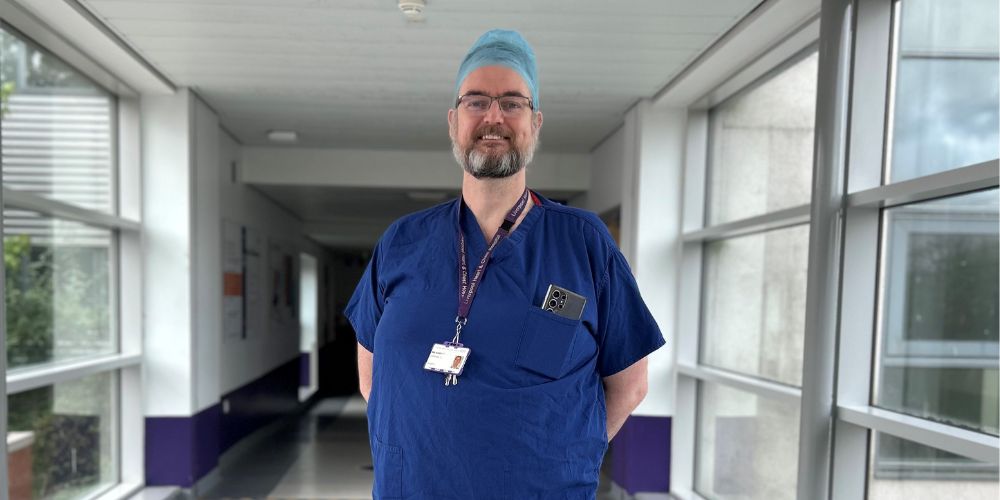
For this instalment of Meet the Specialist, we were fortunate to meet the exceptionally humble Mr Andrew Muir, Cardiac Surgeon and Clinical Lead for Cardiac Surgery (pictured above). Mr Muir has an international reputation for excellence in cardiac (heart) surgery and a special interest in off pump cardiac surgery, mitral, coronary and minimally invasive surgery.
A career in medicine
Asked how his career journey began and why he chose a career in medicine and ultimately cardiac surgery, Mr Muir said:
“An ex-girlfriend wanted to be a doctor, and I thought I could do that! Annoyingly I hadn’t done Biology GCSE, which I needed to study medicine at university in Belfast, and so I ended up having to do this at a local polytechnic at night as it wouldn’t fit into my school timetable.
“I always knew I wanted to be a surgeon. Initially I thought I would do general surgery, and I worked in a tiny hospital in Downpatrick. This was great experience for my first year because we got to cover loads of different operations. I went on to do thoracic surgery, which I enjoyed, but I moved on to do cardiac surgery in 1999 and I loved that even more. I modified my basic surgical training to be solely cardiothoracic; got my first registrar job in 2001 and the rest, as they say, is history.”
The career journey to LHCH
To begin with, Mr Muir worked in a small hospital based ‘in the sticks’ in Belfast. He explained why he put the countryside aside for the city life here in Liverpool:
“I met a trainee from Liverpool at a conference in Hamburg, Germany. He told me that LHCH performed off pump coronary artery bypass surgery, which was a speciality I was, and still am, very interested in. At that point, I contacted LHCH to express an interest in a trainee role and a year later Mr Brian Fabri, a now-retired consultant cardiac surgeon, contacted me to let me know a registrar opportunity had become available. Soon after, I was in Liverpool meeting Mr Mark Pullan, Consultant Cardiac Surgeon, who has also now retired. I got the job, but the day after my visit I broke my leg, so I didn’t start until six months later.
“I started at LHCH in February 2011, and the plan was to get broader experience here for one year and then go back to Belfast. That didn’t happen and I got a locum consultant post in 2012 which became permanent shortly after. I’ve now been here for fifteen years.”
Specialist in cardiac surgery
Talking about his main areas of expertise, Mr Muir shared: “I call myself a coronary, mitral and minimally invasive surgeon. I do some niche work too, such as cardio-oncology and septal hypertrophy surgery.
“LHCH has an extensive team of consultants who each have greater skill in specific areas of surgery enabling them to become true experts in their field. Together, as a decent-sized team, we can effectively serve the population well.”
One of Mr Muir’s main specialisms is off pump coronary bypass grafting, which is also known as beating heart surgery. This is a less common alternative to performing coronary artery bypass grafting, a treatment for coronary artery disease, when a small section of the heart can be immobilised and operated on whilst the rest of the heart continues to beat underneath.
Traditional coronary artery bypass grafting operations use a cardiopulmonary bypass machine to do the job of the heart and lungs, stopping the heart for the duration of the procedure. LHCH is the highest volume centre for this type of technique in the UK.
Mr Muir said: “I’ve completed over 1,000 of these cases now and I am a proctor to mentor, train, support and supervise other doctors in this type of surgery at LHCH, across the UK and Europe. I’ve done this over the last decade.
“We have a strong mitral team at LHCH. About 15% of all our heart operations have a mitral component so we perform around 300 a year. We also have a minimally invasive mitral programme which offers benefits such as reduced recovery time and lower risk of complications. I tend to pick up cases that aren’t suitable for this surgery and tend to be more complex. For example, a patient may need a bypass grafting and mitral valve surgery which would come to me.”
“We have run a programme of minimally invasive aortic valve replacement surgery over the past eight years. Initially it was just me who did this surgery, but now we have six trained consultants, most of whom I taught. LHCH exceeds national levels for operating on aortic valves using a minimally invasive technique and we have plans for this to rise further.
“We also offer minimally invasive multi-vessel coronary artery surgery which has been performed here for three and a half years now since I started the programme. A small number of centres across the UK use this less invasive technique for this operation, but many are not concentrating on multi-vessel.
“Nationally, only 3% of these cases have been completed this way, which we are already matching. I’ve trained two of my consultant colleagues and so now there are three surgeons doing this technique. Our programme is unique, as many centres just have one surgeon who can do these procedures, so we’re fortunate to have such a dedicated team.
“I also provide a septal service for patients with hypertrophic obstructive cardiomyopathy, and I will also be training a colleague in this area. I also support the regional cardio-oncology service for patients with heart disease and cancer, and perform carcinoid heart valve surgery for rarer heart tumours.
“I work closely with several heart teams including high risk, mitral, transcatheter and cardio-oncology. Participating in these important multi-disciplinary team meetings with professionals from across the UK helps ensure that LHCH offers high-quality services for all our patients, whether they need surgery or other treatment. We offer supra-regional services across the North of England as these are highly complex procedures in some of these niche areas.”
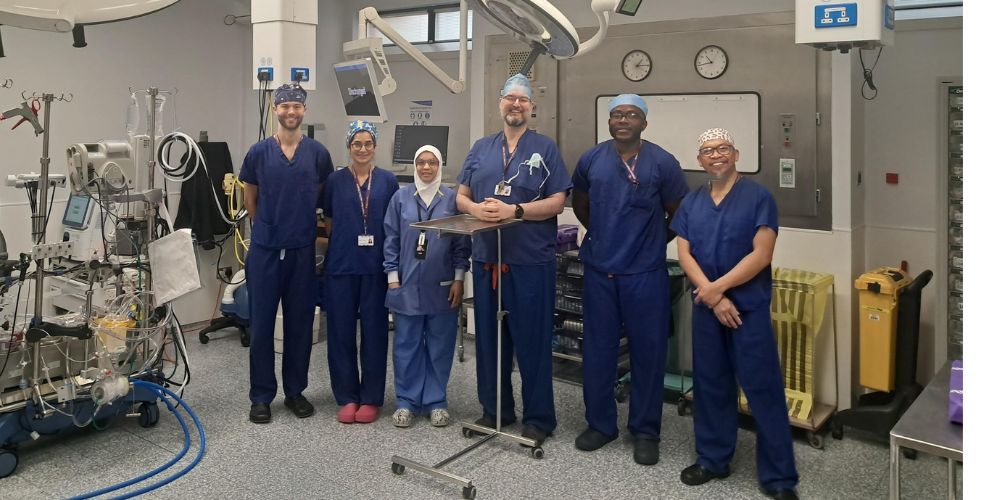
Mr Muir is pictured with his team in theatres
Developments in cardiac surgery
When asked about changes in care and treatment of cardiac surgery over the years, Mr Muir explained:
“We all use more arterial grafts than we used to. They are preferred in coronary artery bypass surgery because they last longer than traditional vein grafts.
“Perioperative care has improved, including prehabilitation and anaesthetic techniques, which has meant faster recovery for patients.
“We are moving to a greater proportion of cardiac surgery carried out less invasively. This is still not widespread, but the outcomes are excellent. For example, 17% of mitral valve surgery is carried out less invasively nationally. At LHCH, we do more than this with more than one surgeon trained in this technique.
“Less invasive aortic valve and coronary artery surgery will follow and continue to rise. We will have multiple surgeons trained on these techniques, so it offers great promise for our patients who are able to go home much sooner after this treatment. It’s going to make a real difference to many. It’s technically challenging and not every patient will be suitable, but it will make a big difference.”
Shaping future surgeons
Incredibly modest when discussing his achievements, Mr Muir shared: “I’m pleased that over half of my operations last year were performed using less invasive surgery, which has had a positive impact on patient outcomes.
“Being able to support and develop cardiac surgeons for the future has been rewarding. I’m a good trainer and proud of this. For example, I’ve been involved in thirteen training programmes in the last three years with a variety of consultant learning agreements and it’s a pleasure to be involved in improving the skill set of colleagues. This is on top of having trained a wide range of resident doctors over the years and being fortunate enough to have received a number of training awards from the Mersey Deanery.
“It’s important to me, that when I retire, I don’t leave a gap of expertise behind. Developing trainees is crucial so that a legacy is left behind.”
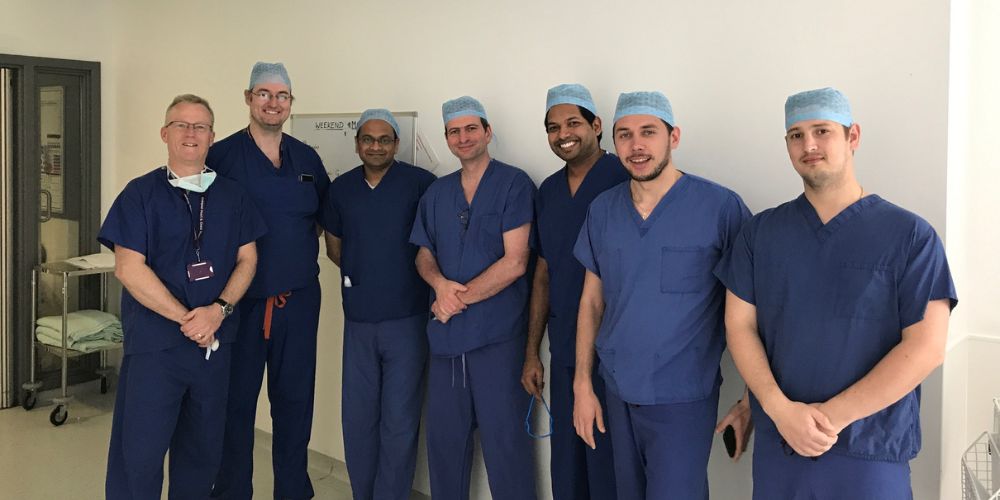
Retired Cardiac Surgeon, Mr Mark Pullan with Mr Andrew Muir who welcomed colleagues from Papworth Hospital NHS Foundation Trust in Cambridgeshire to provide specialist off-pump cardiac surgery training in 2017 as part of the proctored training programme.
Research is key for the patients of tomorrow
Discussing the importance of research in making improvements to future care, Mr Muir explained: “Research is vital. Ten years ago, a colleague, Bil Kirmani and I did a significant research study focused on off- pump cardiac surgery at LHCH. This was the biggest single site study in the literature to date, which we published in an important medical journal called Circulation. The results were impactful.
“The hope is to do more similar studies in the future because it makes such an impact on patient outcomes and experience. I’m really pleased to have been involved and in helping to ensure LHCH continues to be a research leader.”
The future of heart surgery
The future certainly looks bright for cardiac surgery services at LHCH. Asked to share his hopes and plans, Mr Muir added: “Less invasive surgery is the way forward as this can help us treat a greater volume of patients and improve productivity.
“It’s innovative, enables better outcomes for patients and is cost effective. For example, many patients can go home three days post-surgery instead of six. Fewer days in hospital is obviously better for the patient, and it means we have space to treat more patients. I can do two of these minimally invasive surgery operations per day so there is real scope to reduce waiting times and provide the treatment that patients need quicker.
“Coronary artery surgery is our most common operation and so the opportunity for greater productivity and less waiting time, if we increase the proportion we complete minimally invasively, is greatest here. We receive enquiries from outside our catchment area from patients who are willing to travel for this specialist care.”
Outside of work
Asked about his interests outside of work, Mr Muir admits he has a keen interest in light and speaks warmly about his collection of lava lamps and unusual lightbulbs. He also enjoys cooking for family and friends on his self-built pizza oven in the garden, which he admits he spent a lot of time building from scratch with over 3 tonnes of bricks, firebricks and cement!
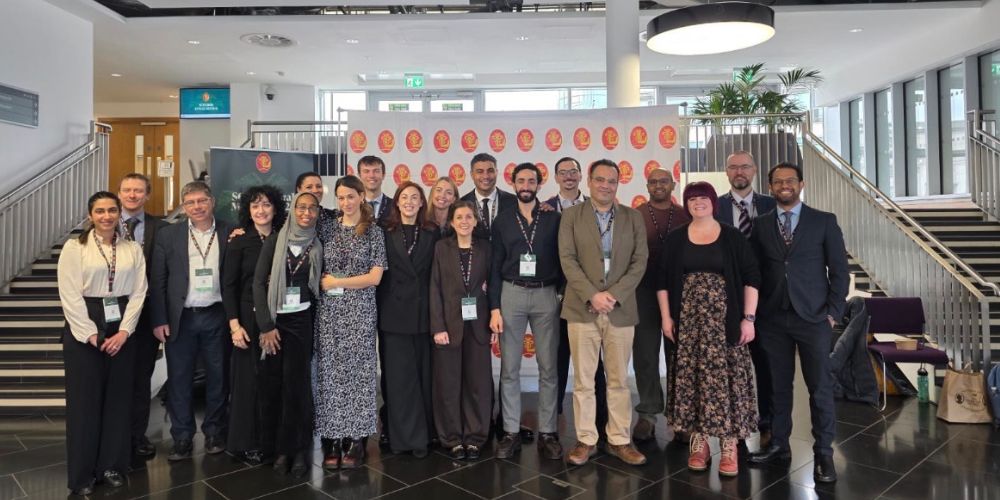
Mr Muir is pictured with LHCH colleagues at the Society of Cardiothoracic Surgery (SCTS) Annual Meeting in March 2026